
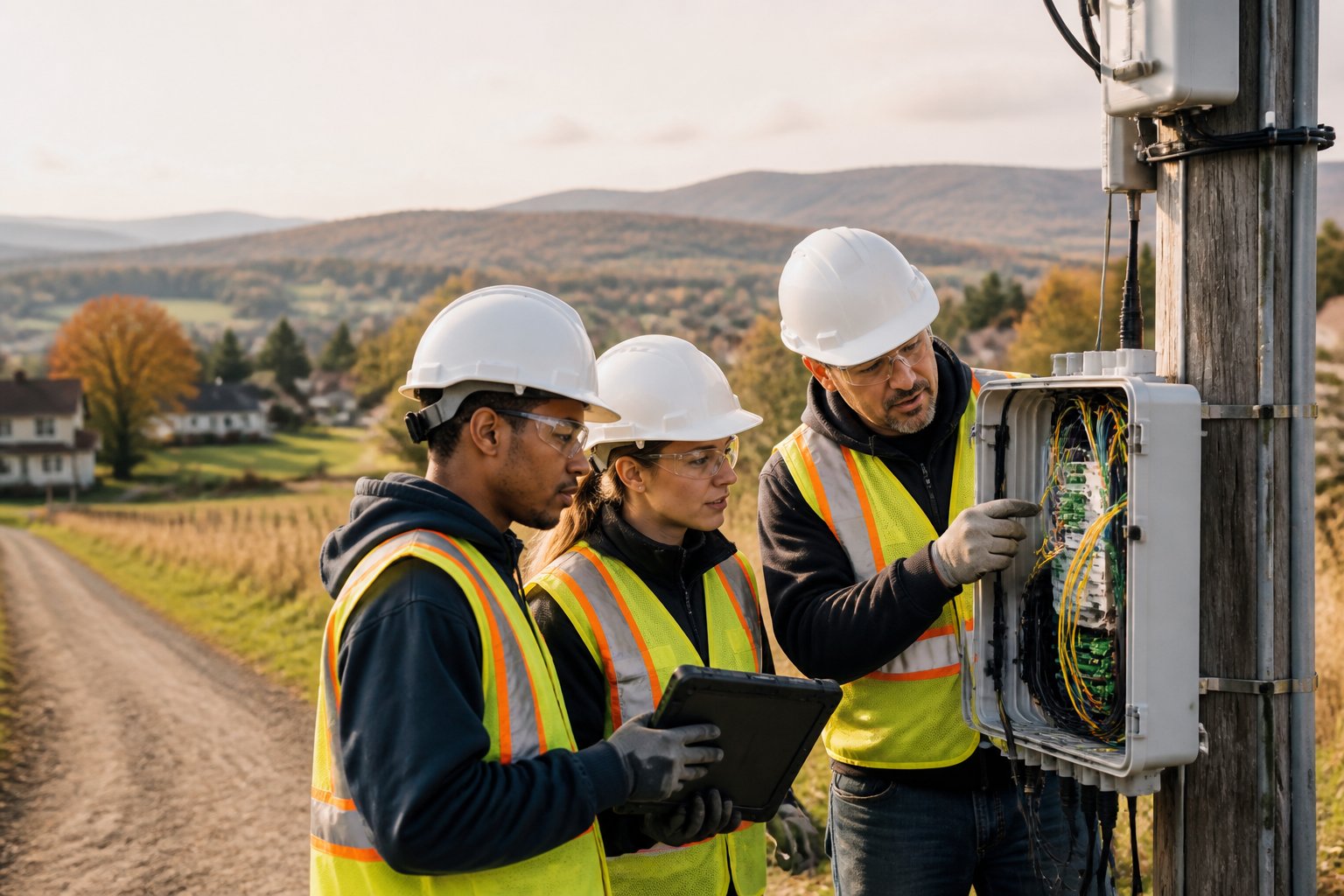
Your state broadband office has moved from mapping to subgrant awards, and the build clock has started. Internet service providers in your region are already asking who will splice fiber, place conduit, and staff drop crews in year one. Meanwhile, your workforce board is fielding calls from county commissioners who want the jobs to go to residents, not travel crews from three states away.
That gap between funded deployment and available labor is where a rural broadband workforce development program earns its budget. Roughly 70% of broadband deployment spending goes to labor, so every mile of funded fiber is really a hiring plan waiting for trained people. Short, stackable certifications tied to actual provider job orders close that gap faster than any two-year degree cycle can.
Keep reading to learn how to fund, design, staff, and measure a broadband training pipeline that holds up under grant review. This guide speaks to program administrators, college deans, workforce board staff, and agency partners, not individual job seekers.
Why BEAD Deployment Needs a Local Talent Pipeline
The Broadband Equity, Access, and Deployment (BEAD) Program is a $42.45 billion federal grant program created by the Infrastructure Investment and Jobs Act (IIJA) and run by the National Telecommunications and Information Administration (NTIA). Money is now converting into construction contracts, and labor is the binding constraint.
The National Shortage of Broadband Technicians and Construction Workers
The White House has projected that the national broadband buildout will create about 200,000 jobs. Industry groups report a persistent talent gap between posted broadband jobs and qualified applicants. Fiber optic cable placement, splicing, and testing all require trained hands, and the telecommunications industry cannot hire its way out with untrained labor.
Why Rural Areas Face Greater Hiring and Contractor Risks
Rural communities carry more of the risk. Low housing density means longer routes, higher per-mile costs, and thinner contractor competition. When local crews do not exist, providers import them, add per diem, and pull those crews to the next state when a bigger project bids higher.
The Job Roles Needed to Build and Maintain High-Speed Internet
Most rural deployments hire against a predictable set of roles:
- Fiber splicers and OSP technicians who place, splice, and test fiber optic cable
- Underground and aerial construction workers running plows, augers, and bucket trucks
- Drop and installation technicians connecting homes and small businesses
- Central office and network operations technicians maintaining active equipment
- Locators and inspectors handling utility marking, permits, and quality checks
- Customer premises and Wi-Fi support staff supporting service after activation
Once you know which roles your providers will hire, the next question is which federal dollars can pay to train for them.
Use Federal Broadband Funds to Support Workforce Readiness
The BEAD Notice of Funding Opportunity (NOFO) named workforce development as a core element of state plans, and all 50 state initial proposals addressed it. Workforce readiness is a scored expectation, not a nice extra.
Eligible Training and Workforce Uses Under BEAD
Training rarely arrives as a standalone check. It flows through subgrantee labor commitments, state administrative and planning dollars, and eligible non-deployment activity described in Initial Proposal Volume I and Volume II. The BEAD Restructuring Policy Notice tightened non-deployment spending, so build workforce costs into deployment scopes and partner budgets instead.
How State BEAD Plans Shape Local Training Opportunities
Read your state's approved volumes like a procurement calendar. Many plans reward subgrantees that document local hiring, registered apprenticeships, and partnerships with technical colleges. If your college can hand a provider a signed training commitment during the application window, you become part of a scored bid, not a later add-on.
Coordinate BEAD With USDA and Other Rural Development Resources
USDA ReConnect loans and grants fund rural broadband construction in the same counties, and its technical assistance and training provisions can support applicant capacity. Workforce board formula dollars can pay tuition, stipends, and supportive services. One credential, several funders, one certified cohort.
Funding only pays off if the curriculum matches what local providers actually hire for.
Design Training Around the Jobs Local Providers Need
Fiber technician training runs in weeks, not semesters. A focused broadband credential with hands-on splicing and testing practice can move a new worker to field-ready status inside a single quarter, which matches provider mobilization timelines.
Map Certifications to Fiber, Network, and Field Operations Roles
Start with three or four job titles your internet service providers name in writing. Then build a stack: a safety and construction basics credential, a fiber optic installation credential, and a network fundamentals credential. Each rung should be hireable on its own so students can earn while they continue.
Blend Hands-On Technical Training With Digital Skills
Field work now includes tablets, test set software, mapping tools, and ticketing systems. Add practical digital skills so graduates read a splice plan and log work correctly on day one. Network security matters too, since providers protect customer data and critical equipment.
That is why cybersecurity credentials stack well onto broadband tracks. The same graduate who splices fiber this year can certify into network monitoring next year, which supports digital equity, digital inclusion, and long-term retention.
Create Entry Points for New Workers and Career Changers
Design for the people who are actually available: farm equipment operators, retail workers, veterans, and displaced tradespeople. Short evening cohorts, no degree prerequisite, and clear entry testing widen the funnel without lowering standards.
Curriculum earns its keep only when employers commit to hiring the graduates.
Build Employer Partnerships That Lead to Local Hiring
NTIA points to industry-led sector partnerships as a best practice for broadband workforce development. In practice, that means a written agreement between your institution, providers, and construction contractors before the first cohort enrolls.
Set Hiring Targets With Internet Service Providers and Contractors
Ask each partner for a number and a date. Twelve splicers by spring, eight drop technicians by summer. Tie cohort size to those numbers, then confirm wage ranges, driving requirements, and certification prerequisites in the same document. Contractors bidding BEAD work will often sign quickly because crew availability affects their bid.
Use Apprenticeships and Internships to Build Field Experience
Classroom time cannot replicate a bad weather aerial job. Registered apprenticeships and paid internships put students on live routes with journey-level supervision, and providers get to evaluate candidates before hiring. Rural telecom cooperatives have been strong apprenticeship partners because they keep crews in the community.
Connect Colleges, Workforce Boards, and Community Partners
Your workforce board can designate broadband jobs as high demand, which frees training dollars and outreach support. Community anchor institutions like libraries, schools, and clinics help recruit and host sessions in counties without a campus.
Partners will hold you to numbers, so decide now which outcomes you will track.
Measure Outcomes That Show Local Economic Value
Grant renewals turn on documented outcomes, not activity reports. State broadband offices and legislators want to see certified people working on funded routes in the counties they represent.
Track Certification, Completion, Placement, and Retention
Collect six data points per cohort: enrollments, completions, credentials awarded, placements with employer name, starting wage range, and 6- and 12-month retention. Record them the same way every term so you can compare cohorts. Add employer and student feedback, since funders increasingly ask for both.
Measure Reduced Contractor Reliance and Deployment Capacity
Economic value shows up as substitution. Track the share of crew hours on local payroll versus imported crews, and the number of resident hires per funded route mile. Providers can usually supply that data because they already track it for prevailing wage and safety reporting.
Report Digital Equity and Community Benefits to Funders
Connect your numbers to the broader goal: households passed, service activated, and local technicians available for repairs after the grant closes. Note wage gains against prior employment and any adjacent hires in maintenance or customer support. That narrative links workforce readiness to real economic growth in your region.
With metrics defined, the remaining work is turning your plan into an enrolled, certified cohort.
Frequently Asked Questions
How Can Rural Communities Train and Certify Workers for Broadband Construction and Installation Roles?
Start with a short stack of credentials covering construction safety, fiber optic installation, and network fundamentals. Pair classroom sessions with hands-on splicing and testing practice, then place students with local providers through apprenticeships or paid internships.
What Funding Programs Support Broadband Workforce Training in Rural Areas?
BEAD state plans, USDA ReConnect projects, and workforce board formula funds are the most common sources. Training costs usually ride inside deployment scopes, subgrantee labor commitments, or state planning and administrative budgets rather than arriving as separate grants.
Which Jobs Are Needed to Build and Maintain Rural Fiber and Wireless Networks?
Fiber splicers, outside plant technicians, underground and aerial construction workers, drop installers, locators, and network operations technicians. Wireless sites add tower technicians and radio installers, and every network needs ongoing maintenance and customer support staff.
How Can Colleges and Training Providers Launch a Broadband Technician Training Program?
Get written hiring targets from providers first, then select credentials that match those job titles. Secure funding through your state broadband office or workforce board, and use a pre-built curriculum and delivery platform to avoid months of internal development.
Does the BEAD Program Allow Funding for Broadband Workforce Development?
Yes, workforce development is part of state BEAD planning, and the program's funding notice treated it as a core element of state proposals. Rules on non-deployment spending have tightened, so coordinate with your state broadband office on current eligible uses.
How Long Does It Take to Prepare Workers for Rural Broadband Deployment Projects?
A focused fiber technician credential can reach field-ready status in a matter of weeks, and a full stacked pathway often runs one to two quarters. Employer apprenticeships then continue skill building on live routes.
Turn a Grant Plan Into a Certified Local Cohort
Most rural programs stall on delivery capacity, not intent. Curriculum development, platform setup, marketing, and employer matching take staff time that small institutions rarely have while a grant clock runs.
That is where a delivery partner helps. Flashpass provides pre-built, employer-informed credentials that launch in as little as 30 days under your own brand and domain, with your name on every credential issued. Enrollment campaigns, live job postings filtered by credential and region, and state-ready reporting come with it, so your team spends time on partners rather than production.
Your build timeline will not wait for a two-year curriculum cycle, and your funders will ask for certified completions in this reporting period. If you are shaping a broadband cohort or writing workforce language into a subgrant application, book a demo and bring your credential goal and target cohort size. Twenty minutes is enough to map a funded path.